Archive for the ‘Uncategorized’ category

Our Growing-Up God That Never Grew Up

July 26, 2020

Andy Stanley talks about the number of young adults and thirty-somethings that have exited the Christian faith that they grew up in. He makes the point that God never grew up as the person grew up.

I’d better explain that a little more.

Kids learned the stories of the Bible and sang simple songs like Jesus Loves Me and Jesus Loves the Little Children. They were good stories and memorable tunes, but then the teenage years arrived along with doubts about faith-based facts. Cause-and-effect came on the scene with high school science classes. They caused adolescents to question the effectiveness of their faith.

The questions became deeper and more cerebral as young adulthood was entered. For many young people the college campus became the clarifying experience as to how deep their spiritual journey was and how much of the Jesus stories and miracles of God did they really believe.

Now back to my first paragraph. Many young adults realized that they were still holding on to the God of their childhood who they had never allowed to grow up, to mature to the point that He could help them in the wrestling matches of what they believed.

Not to be too much of a Debbie Downer, some did experience faith journeys that grew up God as they grew up, but most didn’t. Doubts became sticking points and skepticism became exit doors from the faith.

“The Nones” became a major category for religious affiliation. That is, the person who identifies as a none has no affiliation whatsoever…even atheism. He/she is nothing in particular.  Their childhood faith never grew up. Their grown-up questions stopped being answered.

Honestly, some of the nones became disenchanted with the evangelical church that married itself to the conservative political views, to the point that they didn’t feel comfortable or welcomed anymore.

The Jesus of the scriptures who welcomed questions and dialogue seemed to have disappeared in the places of worship where questions were frowned upon. After a warm welcome at the front door, many nones discovered rigidity in doctrine inside the walls and, therefore, looked for the backdoor exit.

The tragedy in all of this is that Jesus hasn’t changed since he taught on a hillside, gave sight to the blind, and accepted the ostracized off His day. He knew He was the Savior then, just as He is now. He welcomed the children and the grown-ups. Somewhere, however, many of us were stunted in our spiritual growth. We were like the boy who had almost a full beard in 6th grade and was also the tallest and most muscular. Ten years later he was still the same height and muscle-build, and still couldn’t figure out algebra.

I’m far from having everything all figured out, wrapped nicely, and dressed up with a ribbon and bow, but I’ve come to a point where I can ask the Almighty a book load of “Why” questions and not be afraid that I’ll be bolt-smote. There are even times where I haven’t decided what God is going to do, or how He’s going to respond, before He answers; that I’m open to divine surprises, even though they sometimes might be painful.

I’m thankful for Sunday School teachers that I had growing up at Central Baptist Church in Winchester, Kentucky; and First Baptist Churches of Williamstown, West Virginia, Zanesville and Ironton, Ohio. And I’m also thankful for teachers, mentors, and listening ears in my grown years who have journeyed with me in the times of questions and doubts, discoveries and amazement.

I’m pretty sure God has grown up in my life.
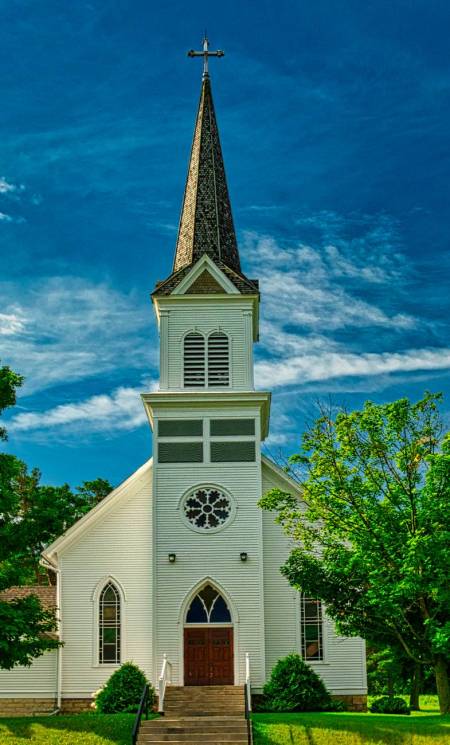
white and brown church

Photo by Tom Fisk on Pexels.com


Fake Jesus Followers

July 24, 2020

Major League Baseball began last night. The Dodgers filled the area behind the backstop with fake fans. That is, cardboard cutouts of people who, evidently, paid for their unreal likenesses to be positioned there. It’s an interesting concept, to say the least. Professional teams are trying to make the game experience for the players as real as possible with piped-in fake crowd noise, public address system announcer, well-groomed fields, and the national anthem. Dr. Fauci threw out the first ball for a Nationals’ game!

The only things missing are the vendors yelling “Beer” as they stroll up and down the aisles, high-fives with a player who hits a home run, and the criminal price that is charged to park at the stadiums. The Oakland A’s even had Tom Hanks be the voice for a virtual hot dog vendor.

For someone to be there, but to not really be there, for a Dodgers home game, will cost the fake fan $299. That’s the price to be in one of those unique field level seats right behind home plate. And, I noticed it was crowded! You don’t have to worry about social distancing if you’re a cardboard cutout.

The Red Sox are charging $500 for someone’s cutout to be positioned above the Green Monster in left field for a portion of the season. The money goes to their foundation. If a home run hits the cutout, the “hit fan” will receive two tickets to a 2021 home game and an autographed baseball. It’s kinda’ like that carnival game with the dolls that a person tries to knock down with a baseball.

It got me thinking about Jesus and a teaching session he had in the 6th chapter of the gospel of John. He talked about being the bread of life and some of his followers found it to be such a hard saying/teaching that they didn’t renew their season tickets…er, that is, they no longer followed him. The season became too tough, too much of a downer. They could no longer put their heart, mind, and soul into following the carpenter from Nazareth.

Cutouts of real people at baseball games is an analogy of Jesus followers in the midst of a crisis. They’re there, but not really. They’ll be back when God gets back to blessing them with problem-free lives, jobs free from stress and worry, and the sanctuary has only smiling faces and the sounds of laughter.

Maybe that sounds cynical…okay, it does sound cynical…but a ballpark with unreal people seems a few steps away from reality. It’s like the sports industry is pretending it’s business as usual. We can pretend like that in church, also, because the book of Lamentations doesn’t fit into the personal theologies of a number of folk.

close up photography of four baseballs on green lawn grasses

Photo by Steshka Willems on Pexels.com

The New Scorned

July 19, 2020

Someone made a comment recently after the Colorado governor instituted a “mask required” in public places requirement, that the number of people with asthma rose sharply. That is, the number of people using asthma as the reason they didn’t need to wear a mask at Walmart shot up like a rocket.

A lady responded that her 8-year-old son does have asthma and breathing is difficult with a mask on. I expressed my condolences to her and told her that I hoped he’d be okay in these coming days.

The situation kept roaming around in my mind last night and it occurred to me that in these tense uncertain days that those who truly can’t wear a mask are the new scorned. They are the ones who will be yelled at and cussed out even though they have a valid reason for, odd as it sounds, showing their whole face.

In the coming days, they will be the ones marginalized by the masses, the latest in a long line of unique individuals ostracized for something they have no control over. Think about it. I can remember when, in our church climate, a divorced person seemed to have a scarlet “D” hanging around their neck. It didn’t matter if the spouse had run off with her best friend, the stigma stuck.

Growing up in a conservative community, there were also those young guys who were viewed with suspicion because they had long hair. Long hair meant anything touching the ears. People mioght cross the street to keep their distance from those boys who were just about another inch away from the juvenile reformatory.

Baptists have looked with suspicion at Pentecostals, physicians at chiropractors, anyone looking at new cars at car salespeople, Target shoppers at Walmart frequenters.

Now, in all the pleading and urgency expressed for people to wear a mask, and the emphasis of each one of us doing our part to stop the pandemic, there are those who legitimately can’t. When most of us see an unmasked person we scoff and invisibly spit him. We assume that he’s being uncooperative and doesn’t care about anyone but himself.

He’s the new leper. In Jesus’ day, someone with leprosy had to call out and say “Unclean” if someone came to close to him. Leprosy was the separater of those who were considered valued and relevant and those who were pushed to the margins and avoided.

Jesus raised a few eyebrows when he showed mercy to the lepers and treated them as precious children of God.

As we go through these difficult days when our anxiety and prejudices seem to rise to the surface, may we not be so quick to judge, but ready to show compassion; more ready to pray than point the finger.

boy wearing surgical mask

Photo by Janko Ferlic on Pexels.com

WISE SILENCE

July 14, 2020

                                            “Wise Silence”

“Even fools are thought wise if they keep silent, and discerning if they hold their tongues. (Proverbs 17:28)”

When I was in sixth grade I learned a valuable lesson the hard way. One of my friends let loose with an expletive right as one of the teachers was walking by. It occurred after the dismissal bell for the school day and, for some strange reason, my warped mind thought that granted me permission to say something insulting to the teacher. I puffed up my 11-year-old chest and yelled, “What are you going to do about it, you ol’ bag?”

I remember the about-face she made and headed back to where my friend and I were standing. My bravado evaporated into the dry ground of the schoolyard as the steam engine came closer. She directed the two of us to go to the principal’s office and she led the way just in case we tried to take a detour. That was back in the days when principals had the feared board of torture called a paddle. A few minutes after entering our principal’s office we exited with our rear-ends on fire.

And I learned that fools, and foolish children, are still thought to be wise if they hold their tongues and remain silent. A valuable lesson that a few people these days could learn…as they sit quietly…and at least pretend to look wise.

Wise is usually shown to be residing by the brevity of a person’s comments, not the volume. The antithesis of a wise person is the individual who seems to be enamored at the sound of his own voice. Through the fog of his chatter foolishness swims around.

That spring afternoon in Williamstown, West Virginia, was the last time I ever entered the principal’s office. It didn’t mean that wisdom had come to roost within me yet, but stupidity didn’t seem to visit as often as it used to.

yellow swing

Photo by Kelly Lacy on Pexels.com

The Generalizing of Bad

July 9, 2020

I used to have this thing about berries. Strawberries excluded since strawberry jam and preserves were as frequent as biscuits in my Kentucky growing up days, I cringed at the thought of blackberries, blueberries, raspberries, boysenberries, and anything else that was berry-related. There was even a guy in school with me named Barry, who I viewed with suspicion.

No one could convince me that berries weren’t all bad. When blue raspberry came out as a 7-11 Slurpee flavor I almost gagged. Raspberry popsicles were of the devil, and I viewed a salad garnished with blueberries as infested.

We have a tendency to categorize as bad something that is slightly related to something else we dislike. I had an American History teacher who succeeded in making the history of our country so bland and boring that I developed the mindset that viewed all of American History as dull and irrelevant. Thankfully, I had a professor for one course in my second year of college that brought it alive. Truth be told, I needed another class and the American History 101 course fit neatfully into a time slot, plus it was close to my dorm. My labeling of all American History being thrown onto the junk pile was completely transformed by that class and I switched my college major to history. Go figure!

Our culture’s tendency to generalize in these recent troubling times has led us down a dark path of suspicions, accusations, and guilt by association. Like associating blueberries with the demonic is a real reach toward the unreasonable, associating all law enforcement officers with the actions of a few makes about as much sense as wearing underwear populated with holes. And sometimes our generalizing of the bad keeps gaining unjustified momentum, like a crazed mob, and there seems to be no end to the pushback. Politicians get on board, athletes go viral with their views, people who have checkered pasts becomes lead spokespersons, and businesses that have no connection to anything that has conspired get looted and/or torched.

Like a teacher having the bad kid in his class before any of the siblings advance

food healthy red blue

Photo by veeterzy on Pexels.com

to that grade level, he has a hard time seeing the others as different than the oldest one who had a membership card for the principal’s office.

Our culture rushes like charging bulls toward ludicrous solutions without any vision of the long-term consequences. Grace, forgiveness, and reconciliation are a few banners that get torn and trampled in the rush.

There are signs of hope. Community prayer gatherings attended by people of different colors and pastors of various faiths have happened. People are dialoguing with one another about how peace might be welcomed back into our cities and neighborhoods. The area of the city we reside in has had gatherings called “Coffee With a Cop”. Neighbors are helping one another and checking to make sure people are okay. Proactive and peace-loving is always better than reactive and revengeful. And things that we never thought could change…change!

Like me and the berries! I’ve come to like raspberries and blueberries. I have them as a part of my breakfast most days of the week. Now I even coach with a guy named Barry! As Jesus said, “Everything is possible for one who believes.”

Micah 6:8 and Maya Moore

July 4, 2020

I’ve never met Maya Moore, but I’d like to someday. Not because she has been one of the top five women basketball players, although we could talk hoops, but because of her calling and passion.

Her calling for the past couple of years has revolved around an inmate in the Missouri State Penitentiary named Jonathan Irons, now 40 years old. Jonathan was convicted of burglary and assault at the age of 16 and sentenced to 50 years.

But Maya, who has known him since she was 18, saw an absence of justice in his situation and she couldn’t ignore it. In 2019 she announced that she would not play the WNBA basketball season and would focus on gaining freedom for Irons. Recently she said she wouldn’t play the 2020 season either because of her driving passion to aging his release.

Recently, that calling was realized as a judge vacated the ruling in the case and Jonathan Irons became a free man. His conviction was wiped off his record. When he stood next to Maya outside the prison walls, his advocate wore a t-shirt with the words of Micah 6:8 printed on the front: “And what does the Lord require of you? To act justly and to love mercy and to walk humbly with your God.”

Words that she has lived by as a result of her strong Christian convictions. How seldom do we see a person’s beliefs be so encompassing of their life that whatever isn’t necessary to their Christ-following slides to the side? So often the Christ gets attached to some other kind of life anchor, like career paths and the striving for significance, and tries to hold on to us.

There is a sense of satisfied exhaling when I read Maya’s grip of Micah 6:8. That she gets it! She might lose financial riches, but she gets it. She may come back and play basketball again, losing two years of her prime, but she gets it. Her anchor holds and the ripple effect of that is that one man is no longer being held.

And, of what I’ve seen of Maya Moore, the last part of that verse…walk humbly with your God…is who she is.

Wow…and praise the Lord!

abandoned ancient antique architecture

Photo by Pixabay on Pexels.com

Rubbing Elbows With the Almighty

July 1, 2020

Touch is a huge quality of a meaningful community of faith. Not that I’ve ever practiced greeting others with a “holy kiss”, although there were a couple of girls in my high school youth group at Ironton (Ohio) First Baptist Church I was open to experiencing that deeper spiritual possibility with,

photo of man and woman doing elbow bump

Photo by Gustavo Fring on Pexels.com

we always had handshakes and hugs. Touch was part of the healing of the hurting, a sign of empathy for another saint in the dark moments of the journey.

Now on Sunday morning, I touch elbows with the other members of the faith community I frequent. Maybe it’s not as giving as a handshake, but it’s a simple recognition of the bond between us.

In the Apostle Paul’s communication with the church of Philippi, known to us as the letter of joy, he writes “Rejoice in the Lord always. I will say it again: Rejoice! Let your gentleness be evident to all. The Lord is near.” (Philippians 4:4-5, NIV)

The Lord is near! In this time of social distancing, it’s God’s way of whispering to me that he’s so close to me that we’re rubbing elbows. He’s so near that, like with my own dad growing up, I can lean on Him.

Some of the most meaningful biblical truths come in the simplest words. Just think about the elbow of the Almighty nudging you slightly, reminding you that the couch of worry you’re planted upon is being shared with the God who provides peace, the One who understands.

His elbow nudge is His reminder that when others wither away and circumstances pile up, He is near. When we lean into Him He will firmly stay with us.

The Problem of Monuments

June 26, 2020

One of my favorite writers of history is Doris Kearns Goodwin. I’m rounding the home stretch of her 2018 book Leadership In Turbulent Times, a fascinating comparison of four former presidents- Lincoln, the two Roosevelts, and LBJ.

In an analysis of how Abraham Lincoln led, Goodwin writes this, “Guided by the principle of forgiveness, Lincoln insisted he did not care if someone HAS done wrong in the past, ‘It is enough if the man does no wrong hereafter.'” (Page 224)

In a time when some seem committed to the erasing of the footsteps of where the American journey has been, we’re discovering that there seems to be no grace period for monuments. What takes lifetimes to create is crashing down in a few minutes of pulling. No statue, it seems, is exempt. If it’s a statue the worst is thought about it. An abolitionist from Philadelphia toppled. Mahatma Gandhi, the promoter of peace, and who Martin Luther King drew inspiration from, was desecrated in Washington, D.C. George Washington was pummeled in Portland, Oregon.

People, like me, are confused by the illogic. It seems as if any statue with the dust of time on it must be prime for removal. There is a longing for past perfection and deafness to the fact that we are all imperfect. Some people were rooted in the idealogy of warped, imperfect systems. Some people were drafted into the purposes of suspect principalities and powers. And some were simply reflective of the opinions and perspectives of their day. But make no mistake about it, perfection was, and is an extinct condition.

So we seem to prefer tearing down instead of building up, defacing instead of forgiving, pulling apart instead of coming together.

Do we rewrite history and rename streets, parks, and institutions that commemorate it? If we “bland-ize” our surroundings we may solve the unrest in our spirits for a moment, but lose sight of where we’ve come from.

Back to Lincoln, the sixteenth president sought a cabinet that brought a mixture of political preferences. Instead of gathering only those who thought like he did, he appointed people who would bring different perspectives, and he valued each one of them. He saw the need for justice and the threats to unity.

However, a statue in Washington, D.C. called The Emancipation Monument has protestors threatening to tear it down because a black man is kneeling beside Lincoln.

architecture usa statue face

Photo by Pixabay on Pexels.com


Granddad’s Butt Chin

June 23, 2020

She has no filter yet. Our five-year-old granddaughter, Corin, verbalizes the raw truth. She just puts it out there for you to chew on.

Yesterday she informed me that I have a butt chin. In her view of the world, my chin resembles two hams squeezed together under one skin covering. The little upswing in the middle assists in the painting of the picture for her. If we were playing Pictionary the question would be is she drawing my chin or someone’s backside?

In her mind, the comment was not meant to be disparaging. She didn’t mean for me to rush off for a shot of chin botox, or to always wear a face mask. She was simply making an observation as if she was seeing a cow in the shape of a cloud or a bunny in a hand shadow.

Sometimes the raw truth saves a lot of time. I have a habit of sauteeing my conversation with words like kinda’, sorta’, and maybe. Corin has never once used those words. Granted, sometimes she gives displays of whining, pouting, and crying to express her dissatisfaction, and dancing, hugging, and jabbering to let us know of her excitement and happiness. But, she never sorta’ says the truth.

Her acknowledgment of my butt chin was followed by her touching it just to make sure it fit her specifications for what a butt chin should look like. And then she leaned into me to let me know I was still her granddad. She does not worry about invading my personal space.

So now I think I’m going to eat salad for the next month and see if I might slim down to a lean cut of meat!

black pig on green grass field

Photo by Brett Sayles on Pexels.com

Dad’s Birthday

June 18, 2020

Today, June 18th would have been my dad’s 92nd birthday. He passed away on February 15th, 2018, just four months shy of ninety.

Lawrence Hubert Wolfe was named after two Baptist deacons who brought his father back into sobriety. Lawrence and Hubert were difference-makers, and my dad carried their names for the next nine decades.

Interesting that my dad was honored as being “Deacon Emeritus” of Beulah Baptist Church in Proctorville, Ohio. Lawrence and Hubert would have been honored to know how valued he was to his congregation.

I carry many of my dad’s mannerisms. Just as he did, I begin many of my sentences with the word “well”. It’s like the prologue for the verbal contribution I’m about to make. Maybe it also was a Kentucky front-porch form of meandering through the path of a conversational subject matter. Well…that’s just what I think about that!

One trait/style I have not carried forward is my dad’s tendency to wear brown socks with his grass-cutting shoes. It’s the only way I can think of that I have tried to steer away from our likenesses. I’m sure my own kids have a whole list of my “doings” that they will seek to close off in a drawer of their memories.

man hands waiting senior

Photo by Pixabay on Pexels.com

I also learned and imitated my dad’s habit of listening before responding. My mom did most of the talking in our family, often entrenched in her opinion just her as father, Dewey Helton, was. When my dad’s tongue voiced a perspective, however, it was usually wisdom-laced and worthy of contemplation. Not that we didn’t listen to our mom, it’s just…well…

Dad served Mom in her deteriorating health, modeling devotion and sacrifice for his kids and grandkids. When Mom’s Parkinson’s minimized her physical functions and her ability to speak, Dad stayed beside her. “For better or worse, in sickness and in health…”, his vow was to remain faithful to his vows.

I miss him but am blessed to have known him and call him “Dad”.